
For many Muslim families living outside a Muslim-majority country, finding a reliable, qualified Quran teacher nearby is genuinely difficult. Mosques may be far away, local class timings rarely fit around school or work, and not every community has a teacher experienced in teaching young children or complete beginners. This is why so many parents and adult learners now choose to learn Quran online instead.
Done properly, learning Quran online is not a lesser alternative to in-person classes — it is simply a different, often more flexible way to get the same thing: consistent, one-to-one attention from a qualified teacher, with proper attention to Tajweed from the very first lesson.
This guide explains how it actually works, what a genuine beginner should expect, and what to look for before choosing a program for yourself or your child.
Why Families Are Choosing to Learn Quran Online
The appeal isn’t really about convenience alone — it’s about consistency. A local class that meets once a week, gets cancelled during bad weather, or depends entirely on one teacher’s availability makes it hard to build a steady learning habit. Online classes remove several of these obstacles at once:
- No commute or location dependency — your child (or you) can join a class from home, which matters most in areas with few or no local Quran teachers
- Scheduling that works around real life — one-to-one online classes can usually be arranged around school, work, or family commitments, rather than a fixed group timetable
- Access to teachers you couldn’t otherwise reach — instead of being limited to whoever is available locally, families can learn from trained teachers regardless of where they live
None of this replaces the value of a mosque community, and no format is automatically better than another — a great in-person teacher and a great online teacher can both produce excellent results, just as a weak version of either can fall short. What actually makes the difference is the quality of the teacher and the consistency of the classes. Where online one-to-one classes have a genuine edge is individual attention: because the session isn’t shared across a group, a good online teacher can often correct pronunciation and Tajweed mistakes more immediately than a busy in-person class might allow.
It’s also worth being realistic about the trade-offs. Online classes depend on a stable internet connection and a reasonably distraction-free space at home, and they don’t offer the physical presence of learning face-to-face in a mosque setting. For many families, especially where no qualified local teacher is available at all, this trade-off is an easy one — but it is a trade-off, not a simple upgrade.
How Online Quran Classes Actually Work
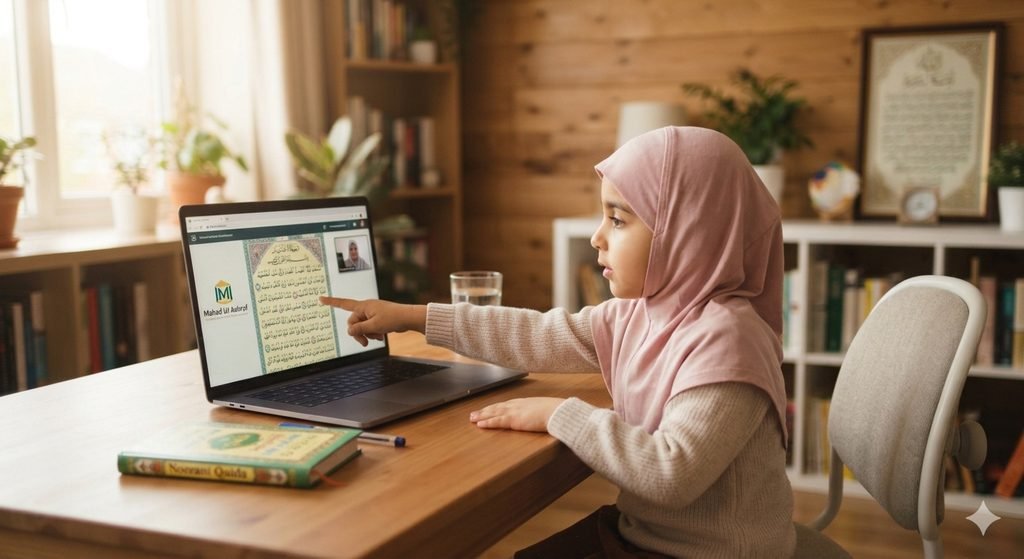
If you’ve never tried it, the format is simpler than it might sound. A typical one-to-one online Quran class looks like this:
- Live video sessions, usually through Zoom or Skype — not pre-recorded lessons, so the teacher can hear you or your child in real time
- Sessions of around 30–45 minutes, scheduled at a time that suits your household
- A teacher who listens and corrects as you go, particularly important for Tajweed, where small mistakes in pronunciation are much easier to fix in the moment than after the fact
Most programs, including ours, begin with a short trial period before any commitment — this matters more than it might seem, because the relationship between student and teacher plays a large role in how comfortable and consistent a child (or adult beginner) feels about continuing.
The Usual Learning Path: From First Letters to Full Recitation
Every learner starts somewhere different, but most structured programs follow a similar progression:
1. Noorani Qaida — The Foundation
For anyone starting from zero — most commonly young children, but also adult beginners — Noorani Qaida is the standard starting point. It focuses on recognizing Arabic letters, their correct pronunciation, and basic reading rules, before moving into the Quran itself. Skipping this stage is one of the most common reasons students struggle later with Tajweed.
2. Quran Reading
Once the basics are solid, students move into reading directly from the Quran, applying what they’ve learned about letters and sounds to real verses.
3. Tajweed
Tajweed refers to the rules governing how the Quran should be correctly pronounced and recited — things like where to pause, how certain letters interact, and correct articulation points. This is best learned with a live teacher who can hear and correct pronunciation directly, which is one of the clearest advantages of one-to-one classes over self-study apps or recorded videos.
4. Memorization (Hifz)
For students who want to go further, memorization is usually introduced once reading and Tajweed are comfortable, and progresses gradually — a portion at a time, with regular revision built in.
There’s no fixed timeline that applies to everyone. Progress depends on the learner’s age, consistency, and how much practice happens between classes, so it’s worth being cautious of any program that promises a fixed number of weeks to “finish” the Quran.
What to Look for Before Choosing an Online Quran Program
Since the format is now common, quality varies a lot between providers. A few things worth checking before committing:
- A real trial class, not just a sales call. The clearest way to judge a teacher is to sit in on an actual lesson.
- True one-to-one teaching, rather than large group sessions where individual correction is limited.
- A clear starting point for true beginners. If you or your child don’t know the Arabic alphabet yet, make sure the program actually starts there rather than assuming prior knowledge.
- Teacher experience with your specific situation — teaching a 6-year-old and teaching an adult beginner require different approaches, so it’s reasonable to ask directly about a teacher’s experience with your age group.
- Flexibility for missed classes, since life happens — ask what the policy is before you need it.
- Availability of both male and female teachers, which matters to many families, particularly for daughters.
Setting Your Child Up for a Good First Class
A student’s first few online classes tend to go more smoothly with a little preparation. None of this is complicated, but it makes a real difference:
- Choose a quiet, consistent spot. Sitting in the same place for each class — away from a TV or busy room — helps a young child settle into a routine faster than switching locations every time.
- Test the tech beforehand, not during the lesson. A quick check that the camera, microphone, and internet connection are working before the scheduled time avoids losing the first few minutes to troubleshooting.
- Keep a copy of the Noorani Qaida or Quran text on hand, whether printed or on a tablet, so the student can follow along with the teacher rather than sharing a single screen.
- Encourage short daily practice between classes, even five to ten minutes. Consistency between lessons matters more for retention than the length of any single class.
- Sit in occasionally, especially for younger children. A parent doesn’t need to be present for every session, but checking in now and then helps you understand how your child is progressing and whether the pace feels right.
Signs You’ve Found a Good Teacher
Beyond qualifications on paper, a few practical signs tend to indicate a teacher who will work well long-term:
- They correct pronunciation gently and clearly, rather than simply repeating a word without explaining what to change.
- They notice when a student is losing focus and adjust — a change of pace, a short break, or a different approach — rather than pushing through a fixed lesson plan regardless.
- They give you, as a parent, a clear sense of what was covered and what to practice before the next class, rather than leaving progress vague.
- They’re comfortable answering direct questions about their teaching background and experience with your child’s age group.
These are the kinds of things a trial class is genuinely useful for — they’re much easier to judge by watching a real lesson than by reading a teacher’s profile.
Frequently Asked Questions
Do I need to know Arabic before starting? No. Noorani Qaida is specifically designed for complete beginners, whether that’s a young child or an adult who has never learned the Arabic alphabet.
What age is right for a child to start learning Quran online? There’s no single “correct” age — it depends on the child’s attention span and comfort sitting through a short lesson. Many families start with Noorani Qaida once a child is old enough to focus for 20–30 minutes, and a good teacher will adjust pace and style based on the child’s age.
How long does it take to read the Quran independently? This genuinely varies from student to student, based on age, consistency of classes, and practice at home. Rather than a fixed number of weeks, progress is better measured lesson by lesson.
Is it normal for an adult to feel nervous about starting as a beginner? Yes, and it’s common. A good teacher adjusts their approach for adult learners rather than treating every student the same way children are taught.
What do we need technically to join a class? A laptop, tablet, or smartphone with a camera and microphone, a stable internet connection, and Zoom or Skype installed.
Can we try before committing to a paid plan? Yes — this is genuinely the most useful step before choosing any program, since it lets you judge the teaching style directly rather than deciding based on a website alone.
Getting Started
If you’re ready to begin, the most useful first step isn’t reading more — it’s sitting in on a real class. At Mahad Ul Ashraf, every new student starts with 3 days of free trial classes, with no payment details required, so you can see the teaching style and decide with confidence.
If you or your child are starting from the very beginning, our Noorani Qaida course is the natural first step, covering Arabic letter recognition and pronunciation before moving into full Quran reading with Tajweed.
Ready to begin? Book your 3-day free trial class today and meet your teacher before you commit to anything.